A 400-year-old Lucknow tradition
Lucknow has been setting its table every Tuesday of Jyeshtha for four hundred summers.
Lucknow does not feel small in the month of Jyeshtha. Streets that usually thin out by mid-afternoon stay loud well past dusk; canopies bloom on footpaths in saffron and white; the air carries puris frying in three different mohallas at once. Tuesday, Mangalwar, becomes a city-wide kitchen, a city-wide langar, a city-wide remembrance. Strangers are fed. Families pool their stoves. Police chowkis pause to accept a plate. For one day a week, in the hottest month of the Hindu calendar, this old Awadhi capital insists that nobody who walks past should walk past hungry.
This is Bada Mangal. The bigger Tuesday. And it is older than most people guess.
Chapter 01
The Tuesday
Mangalwar (the day named for the planet Mars) has been associated with Hanuman Ji for as long as anyone has written about him. It is on a Tuesday in the month of Jyeshtha, the local tradition holds, that Hanuman first met Lord Rama in the forests of Kishkindha. Every Tuesday in this month therefore carries the imprint of that first meeting; every such Tuesday becomes Bada, the bigger one, the more auspicious one, a day on which devotion is not only personal but communal.
In most of north India, this stays a quiet personal observance: a fast, a Chalisa, a visit to the local Hanuman temple. In Lucknow, somewhere between the eighteenth century and the present, it became something larger. It became civic.
Chapter 02
The Nawab and the Begum
The story almost everyone in Lucknow tells begins with the Nawab Saadat Ali Khan II, who ruled Awadh between 1798 and 1814. The Nawab's young son was gravely ill. His Begum (the local versions differ on her name, with several pointing to a woman remembered as Janaab-e-Aliya) vowed that if the boy recovered, she would build a Hanuman temple in his honour.
The boy recovered. The Begum kept her word.
A new Hanuman temple rose in what was then the open ground north of the old city, on land near a small village called Aliganj. It was inaugurated, by most accounts, on a Tuesday in Jyeshtha. To mark the day, food was distributed (a bhandara) to anyone who had walked there. The crowd was larger than expected. The food held out. The next year more people came, and more bhandaras were laid. The pattern set.
Chapter 03
The first Aliganj temple
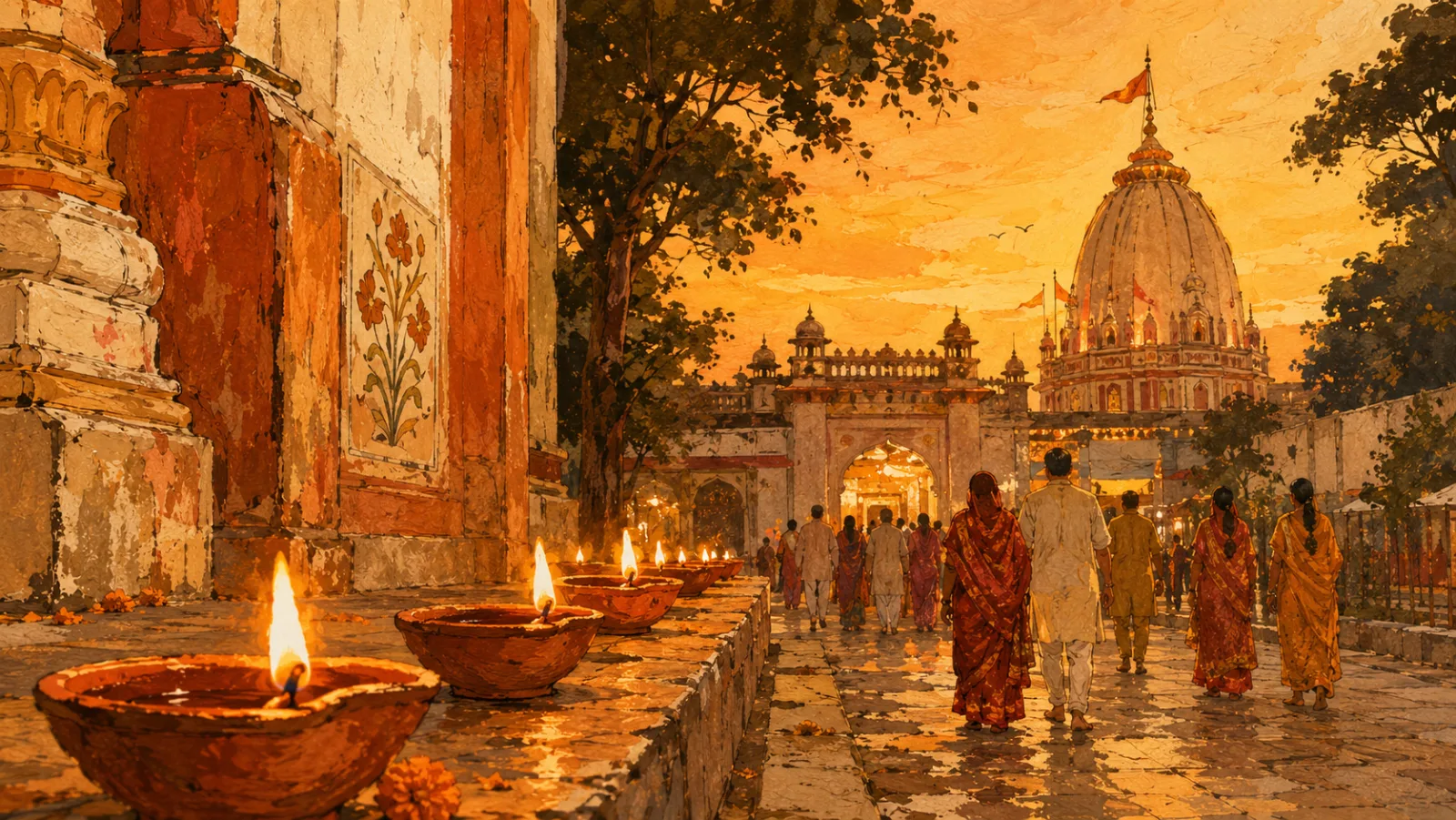
The Aliganj Hanuman Mandir, sometimes called the Naya Hanuman Mandir ("the new" Hanuman temple, to distinguish it from the older one nearby), became the geographic heart of Bada Mangal. Its arched gateway, its painted murti, its cool stone floor in the worst summer heat: these are the textures the festival carries forward. To this day, the streets around Aliganj swell into a mela on every Bada Mangal, with bhandara canopies running unbroken from the temple gate down toward the police chowki and beyond.
The temple is not architecturally the largest in the city. It is religiously the centre of gravity.
Chapter 04
Bhandara as community
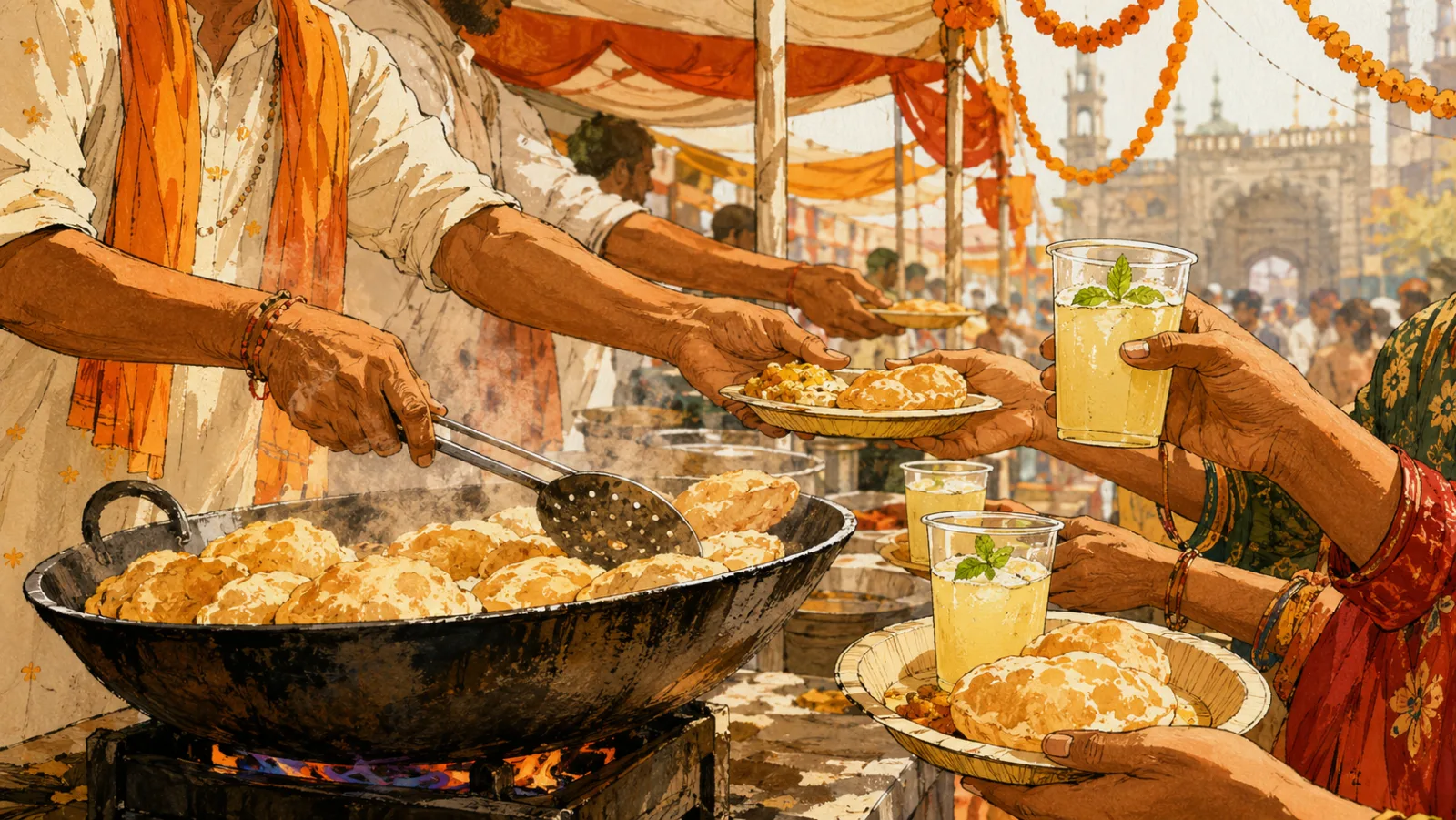
A bhandara is a community kitchen: at its simplest, a stove and a stack of plates and the conviction that you do not eat alone. In Sanatan Dharma, the act of feeding others is a form of seva, a service that elevates the giver as much as the receiver. In Lucknow, the bhandara grew from a single ritual at a single temple into a city-wide reflex.
By the early twentieth century, families had begun setting up their own canopies on neighborhood corners. Shopkeepers did the same. Mohalla committees pooled funds for week-long arrangements. The food simplified into a few staples (puri, sabzi, halwa, sometimes biryani for the larger pandals, always sharbat and water for the heat), but the scale grew without limit.
Today a typical Bada Mangal in Lucknow sees more than twenty thousand bhandaras across the city. More than forty lakh meals are served on a single day. There is no central organizer. There is no choreography. The city simply remembers.
Chapter 05
A festival of all faiths
Bada Mangal is, in its origin and in its practice, an inclusive festival. The very building of the Aliganj temple, by a Begum's vow, sits at a crossroads of Awadh's pluralism. It is not lost on anyone who walks Lucknow's streets on a Tuesday in Jyeshtha that some of the most generous bhandaras are laid out by Muslim shopkeepers, who set up canopies offering chilled water and sharbat to anyone passing in the heat. Sikh families bring out langars. Christian neighbors arrive with cold lassi. The Lucknow Bada Mangal has, for two centuries, refused to be only one thing.
It is one of the few large public Hindu festivals in India that visibly carries the city's older Ganga–Jamuni tradition forward. The Nawab Wajid Ali Shah, in the mid-nineteenth century, is recorded to have personally encouraged the Bada Mangal festivities at Aliganj. That gesture, a Shia Muslim ruler patronizing a Hanuman shrine, is the spine of the festival's modern character.
“Lucknow's Bada Mangal is not a religion's festival. It is a city's promise.”
Chapter 06
The summer's role
Jyeshtha falls in the worst stretch of the north Indian summer. Temperatures cross 42°C; the loo blows from the west; the city slows. Into this heat, the Bada Mangal pours its water. Free chilled sharbat, in tetra packs and steel glasses. Earthen matkas of cool water, refilled hourly. ORS, sometimes; a quiet modernization. Watermelons. Cucumber slices.
The festival's deepest unwritten rule is that no one is turned away. A passer-by who stops at a sharbat stall is not asked who they are or where they come from. The cup is poured. The cup is drunk. The cup is handed back. That is the whole exchange. In the punishing heat of a Lucknow June, this is more than ritual: it is a practical kindness scaled across a city of three million people.
Chapter 07
The modern day
The contemporary Bada Mangal is an extraordinary act of distributed organization. Twenty thousand bhandaras do not coordinate themselves on paper. They coordinate by habit. Families pull funds. Local shopkeepers donate atta and oil. RWAs reserve street corners. Police arrange traffic. Corporate houses sponsor pandals. The Lucknow Municipal Corporation now provides a registration line, sweeps the streets after, and enables a baseline of order over what is otherwise a beautifully unruly civic event.
The food has industrialized. The spirit has not. A child still walks home with a tilak on the forehead, holding a paper plate of halwa-puri.
Two centuries, five turns
1798–1814
Nawab Saadat Ali Khan and the founding vow.
~1854
Wajid Ali Shah's patronage of Aliganj.
1947
Independence; the festival absorbs new families displaced into Lucknow.
2007
Lucknow Municipal Corporation begins formal coordination.
2026
The rare 8-Tuesday cycle, due to Adhik Maas in Jyeshtha.
1798–1814
Nawab Saadat Ali Khan and the founding vow.
~1854
Wajid Ali Shah's patronage of Aliganj.
1947
Independence; the festival absorbs new families displaced into Lucknow.
2007
Lucknow Municipal Corporation begins formal coordination.
2026
The rare 8-Tuesday cycle, due to Adhik Maas in Jyeshtha.
Chapter 08
Why 2026 is rare
The Hindu calendar is luni-solar. Roughly every nineteen years, the lunar month of Jyeshtha overlaps an additional intercalary month (Adhik Maas), and the count of Tuesdays inside it rises from the usual four or five to eight. 2026 is one of those years. Eight Bada Mangals. Eight times the city sets its table. Eight Tuesdays of remembrance for an event that began with a Begum's vow and has refused, across two centuries, to end.
The dates: May 5, May 12, May 19, May 26, June 2, June 9, June 16, June 23.

You do not need to be from Lucknow to walk into a Bada Mangal bhandara. You do not need to bring anything. You do not need to know the song the speaker is playing. You only need to be hungry, or thirsty, or in the heat, or simply curious. The plate will be handed to you. The water will be cool. Hanuman Ji will be on the wall, or on the speaker, or in the conversation around the next stove.
Find a bhandara near you on the map. Or, if you have laid one yourself, tell the city where to find you.
That is the whole platform. That is the whole tradition.
॥ जय श्री राम । जय हनुमान ॥
Find a bhandara near me
See every bhandara on the map →
Add a bhandara
Add yours to the listing →